Sealing and environment · Updated 2026-09-28
Connector Shell Finishes and Salt-Spray Ratings
The shell finish decides how long a connector survives corrosion, how well it carries shield current and whether it is RoHS compliant.
Comparison (38999-type examples)
| Finish | Neutral salt spray | Shell conductivity | Notes |
|---|---|---|---|
| Aluminum, electroless nickel | 48 h | 1 mΩ | General purpose, good shielding, RoHS |
| Aluminum, olive-drab cadmium | 500 h | 2.5 mΩ | Classic high-corrosion finish, not RoHS |
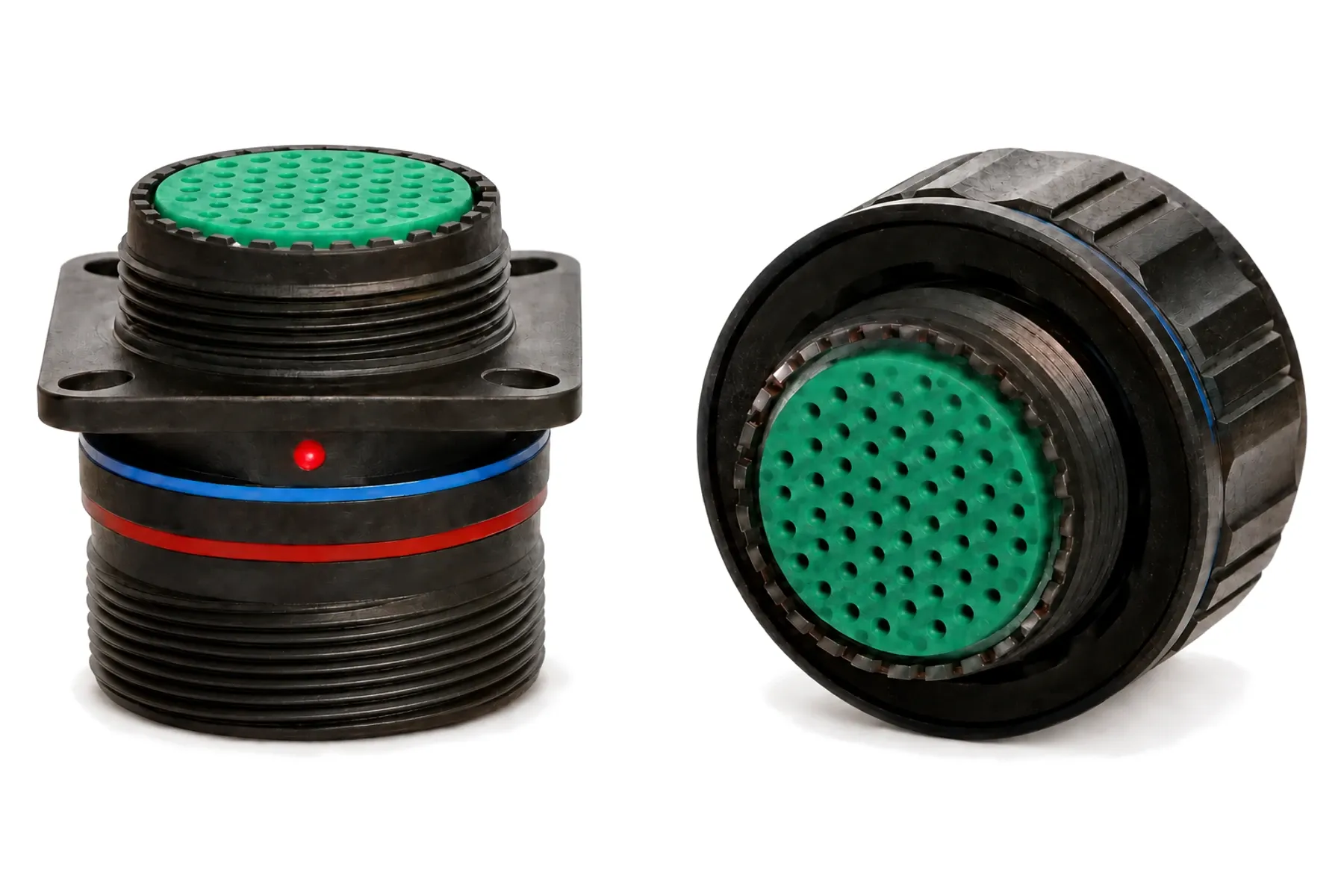
| Aluminum, nickel-PTFE | 500 h | 2.5 mΩ | Cadmium-free corrosion resistance |
| Stainless steel, passivated | 500 h | ~10 mΩ | Strong, heavier; hermetic versions |
| Composite, nickel | 2000 h | 3 mΩ | Light and very corrosion resistant |
| Titanium | 500 h (to 1000 h in some families) | 10 mΩ | Highest strength-to-weight; seawater resistant |
Values differ between product families — check the finish table on each series page.
Acid salt spray and marine grades
Neutral salt spray is a basic comparison test. Marine and offshore equipment often specifies acid salt spray and acid-atmosphere tests, which are harsher. Typical conditions used for our marine connectors:
| Test | Conditions |
|---|---|
| Acid salt spray | 35 ± 2 °C, 5 % NaCl, pH 3.5 ± 0.5; cycles of 24 h spray and 24 h drying, 240 h in total |
| Acid atmosphere | Same solution; 3 cycles of 2 h spray + 22 h storage, then 4 cycles of 2 h spray + 7 days storage |
| Mould | 84 days, grade 1 or better (GJB 150A.10) |
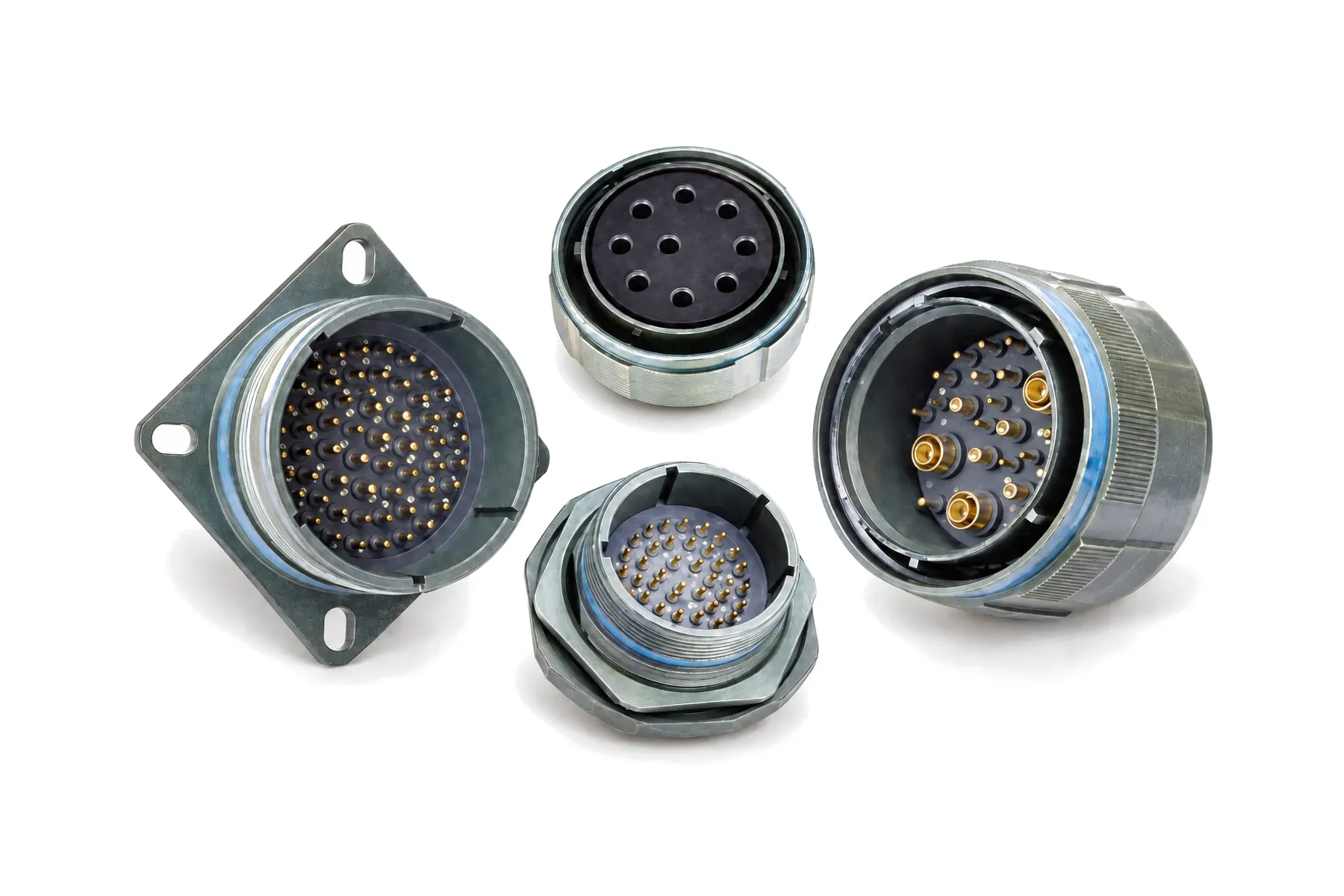
Our J599WR connectors use a cadmium-free nickel-PTFE finish tested to 240 h acid salt spray. The marine-environment (M) versions of J599 Series III and GJB 599 Series I and II, and the XCA bayonet connectors, are made for these tests with stainless-steel or titanium shells for exposed locations.
Choosing a finish
- Indoor industrial: nickel on aluminum.
- Outdoor, rail, offshore: nickel-PTFE, composite or stainless; cadmium only if your standard requires it and RoHS does not apply.
- Subsea: titanium or suitable stainless/bronze grades.
- Weight-critical: composite or lightweight micro circular types such as XY2.
- EMI-critical: choose a finish with low shell conductivity and good shielding figures.
We supply mixed finishes on request, for example stainless receptacles with aluminum plugs.