Rugged computing · Updated 2026-09-28
Choosing Liquid-Cooling Quick-Disconnect Connectors
Liquid-cooled electronics use quick-disconnect fluid connectors so that modules can be removed without draining the loop. The right size keeps pressure drop low without wasting space.
Flow and pressure drop
Manufacturers give a Kv value: the flow in m³/h that produces a pressure drop of 1 bar. For other flows:
Δp (bar) = (Q / Kv)², with Q in m³/h (1 L/min = 0.06 m³/h).
Example: an LTK10 connector (Kv 3.57 m³/h) at 20 L/min (1.2 m³/h) gives Δp ≈ (1.2 / 3.57)² ≈ 0.11 bar.
| Model | Bore | Max. flow | Kv |
|---|---|---|---|
| LTK03 | 3 mm | 2 L/min | 0.22 m³/h |
| LTK05 | 5 mm | 5.8 L/min | 0.79 m³/h |
| LTK08 | 8 mm | 15 L/min | 1.93 m³/h |
| LTK10 | 10 mm | 23.55 L/min | 3.57 m³/h |
| LTK12 | 12 mm | 33.9 L/min | 5.41 m³/h |
| LTK16 | 16 mm | 60 L/min | 8.6 m³/h |
Spillage
Every disconnection loses a small amount of coolant trapped between the valves. For TSA connectors it ranges from 0.002 cm³ (3 mm) to 0.09 cm³ (15–20 mm). For electronics, choose the smallest bore that meets your pressure-drop budget.
Other checks
- Working pressure: 20 bar for LTK-T and TSA.
- Temperature and seals: EPDM for water-glycol to +95 °C; fluorosilicone to +155 °C; LTK-T to +175 °C.
- Coolant compatibility: deionized water, glycol mixes or dielectric fluids — tell us which.
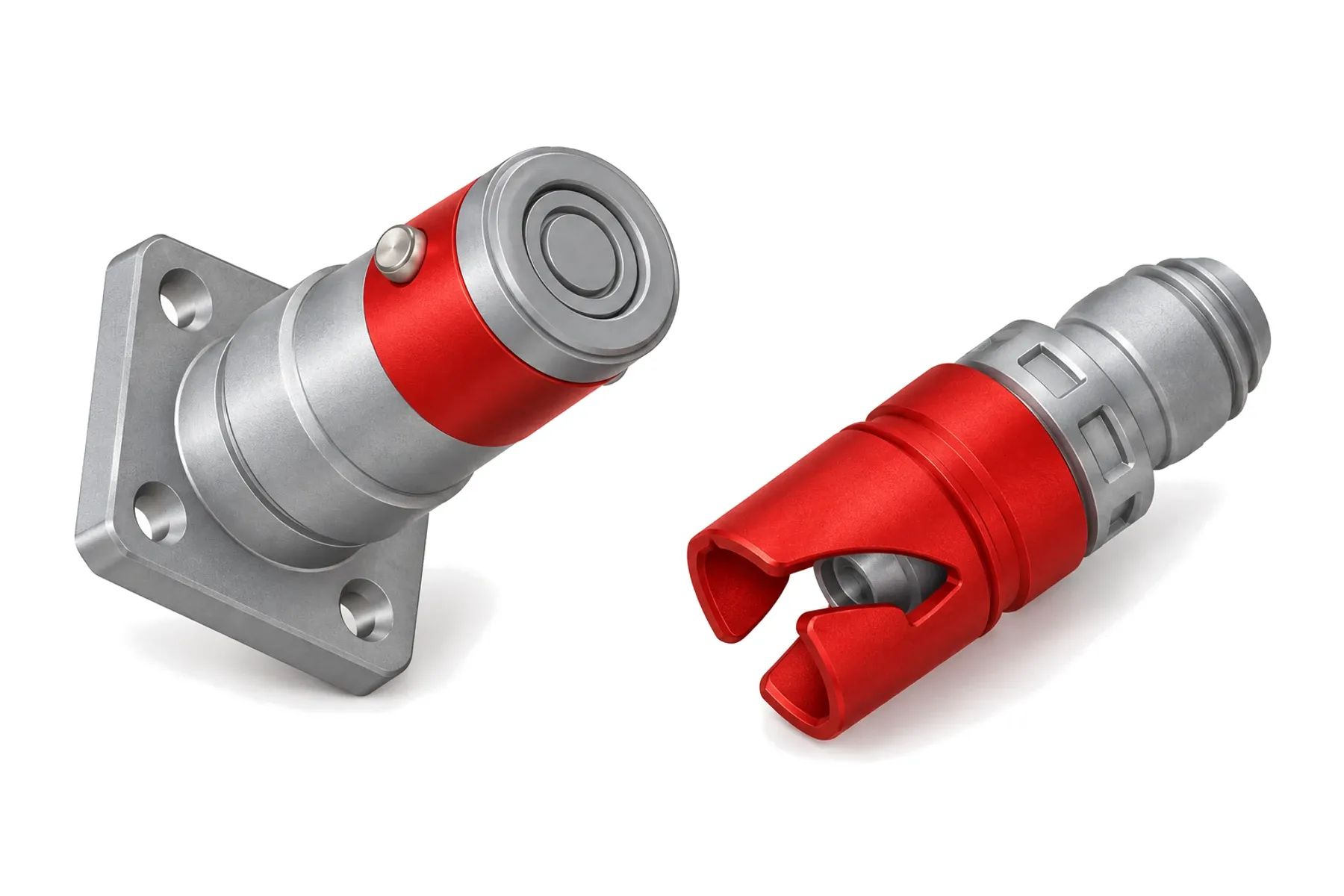
- Colour coding: red, blue, green and yellow rings prevent supply/return mix-ups.
- Shock and vibration: tested with pressurized fluid inside.